
What We Do2026-08-22T17:29:53+00:00

What we do.

It’s never been more important for B2B marketers to focus on the levers that make a difference.

“The future of B2B marketing won’t be about doing the same with less, but rather doing better with less.”

Forrester Budget Planning Guide 2025: Demand and ABM

This is where marketing intelligence comes in.
But, not all intelligence is created equal.

Ei’s model for B2B marketing intelligence delivers better outcomes for B2B sales and marketing leaders.

Evidence. Confidence. Results.

It’s never been more important for B2B marketers to focus on the levers that make a difference.

“The future of B2B marketing won’t be about doing the same with less, but rather doing better with less”.

Forrester Budget Planning Guide 2025: Demand and ABM

This is where marketing intelligence comes in.
But – not all intelligence is created equal.

Ei’s model for B2B marketing intelligence delivers better outcomes for B2B sales and marketing leaders.

Evidence. Confidence. Results.

Our People, Technology and Process help marketers and salespeople make smarter decisions.

Our People

Our expert consultants enable B2B Marketers and customer-facing teams to make informed decisions when engaging niche audiences through ABM, content or go-to-market activities.

We do this by living and breathing B2B industries and strategies, constantly staying ahead of the latest trends.

our people
our people

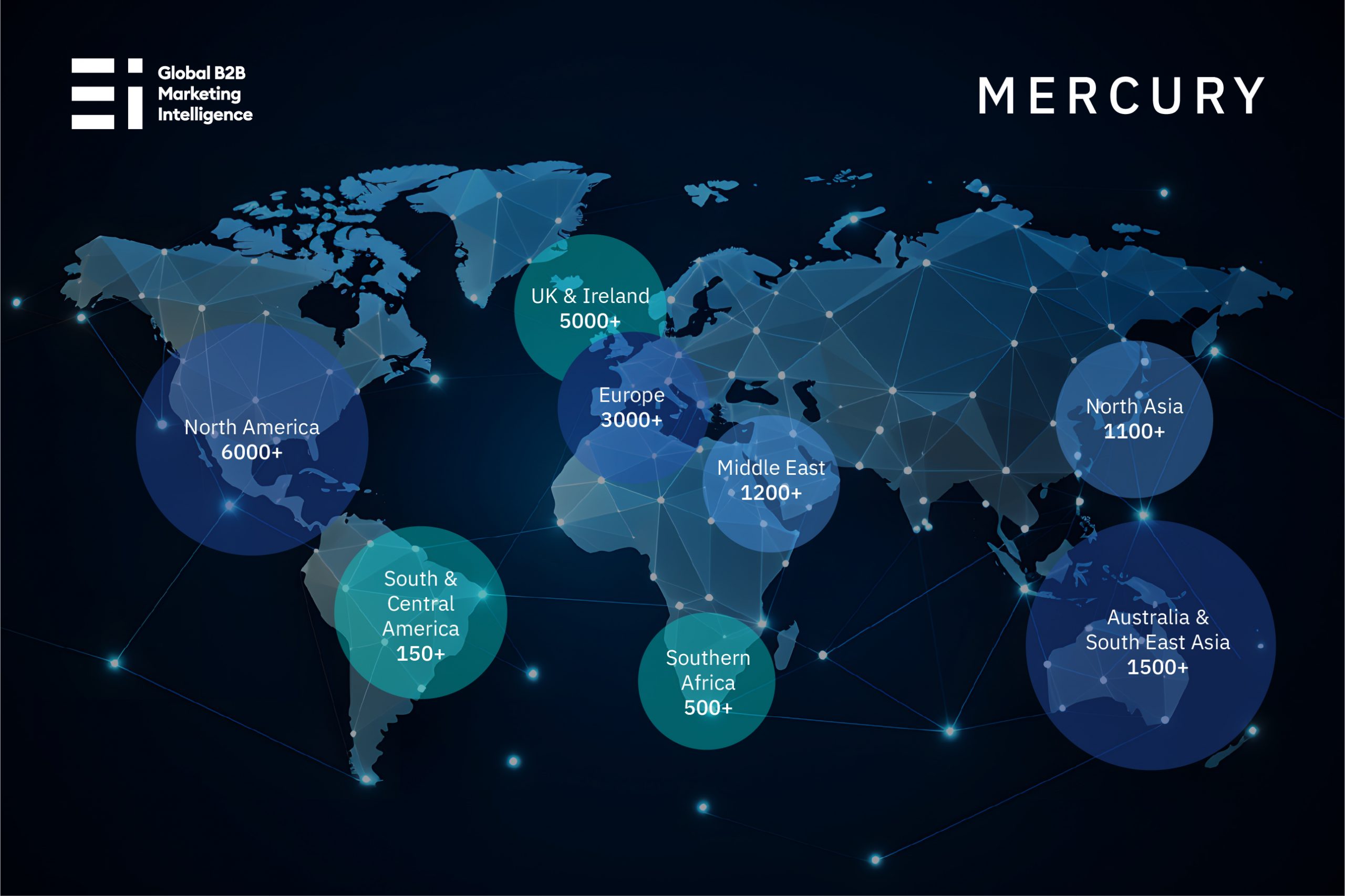
Our Technology tracks 11,000+ B2B GTM opportunities

Launched in 2010, Mercury is our proprietary technology. Built into every client program we run, Mercury tracks the full spectrum of B2B media providers and activities, covering every industry and every corner of the world.


Process

Our Process

We combine human skill and knowledge with real data sources to provide B2B intelligence that delivers better outcomes.

We see AI as an enabler of human intelligence, and use it to unlock greater efficiency, creativity and strategic thinking.

Our AI-powered process ensures analysts spend time on what matters: delivering high quality, actionable B2B intelligence for clients.

Questions we get asked

What does working with Ei Advisory actually look like?2026-08-22T16:59:42+00:00

We work as an extension of your team, not as an outside agency dropping in a deliverable. Every project starts with a thorough briefing process to make sure we understand your objectives, your market, and your account priorities before any work begins. Through the project, we run regular check-ins to keep direction aligned with what you need, rather than surfacing a finished output at the end with no visibility along the way. And we support execution, not just strategy, so the output is something your team can actually put into action.

What does your go-to-market capability actually cover?2026-08-22T17:00:06+00:00

Go-to-market for us means identifying the right channels to reach your audience, not just the obvious ones. We draw on Mercury, our proprietary database of B2B media, communities, associations, and business schools globally, built over eighteen years, to map where your target executives actually engage. Increasingly, that points toward events and in-person, experiential engagement as one of the highest-value channels available in a market where digital content has become noisy and interchangeable.

How do you help us build a stronger pipeline with key accounts?2026-08-22T17:00:25+00:00

This is about finding the right routes into the accounts that matter. We map stakeholders and organograms to identify the real decision-makers and influencers, then find creative ways to reach them. We draw on Mercury, our proprietary database of B2B media, communities, associations, and business schools globally, built over eighteen years, to understand where those executives actually show up and to focus go-to-market activity on the right channels to reach them.

How do we measure the impact of intelligence on our marketing and sales activity?2026-08-22T17:00:52+00:00

Impact comes from focus: reaching the right people, at the right time, with the right message, and tracking the incremental gains that focus produces. We anchor measurement around metrics like pipeline influence, but the underlying principle is that targeted, well-sequenced activity consistently outperforms broad activity, and that’s what we measure against.

How do we stand out when everyone is saying the same thing?2026-08-22T17:02:02+00:00

Standing out comes from being precise about who you’re trying to reach, how they think, and how they actually engage with your brand, then being selective rather than broad. Doing fewer things well outperforms doing more things adequately.

Our messaging intelligence uses a proprietary methodology, LENS: Listen to the voice of the customer through interviews, direct quotes, and market data; Extract the themes that matter; Navigate competitor positioning and investment activity; Shape messaging based on what that analysis reveals. It’s how we move from “everyone sounds the same” to messaging that’s actually built on what your specific audience cares about.

How do you help us understand what our target accounts actually care about?2026-08-22T17:02:30+00:00

This is account intelligence, and it runs on verified data rather than synthetic or assumed data. We identify the real executives at your target accounts, and build a picture of what they care about from what they’re actually saying and doing in the market, not from a modelled guess at what people in their role typically think. That grounding in verified, real-world signal is what makes the account intelligence usable rather than generic.

What’s the difference between AI tools and human intelligence in marketing?2026-08-22T17:03:21+00:00

This isn’t really a dichotomy. The two work best together. AI is good at processing volume and surfacing patterns fast, but that strength is also its weakness: it tends to work at a surface level and can mistake the first slice of information for the whole picture, drawing conclusions before it’s actually covered the full landscape. Ensuring a picture is genuinely comprehensive, not built off an incomplete sample, is still a human job. AI also isn’t reliable at contextual understanding: knowing how people actually think and communicate, or correctly interpreting who said what, in what context. Where AI adds real value is turning validated insight into action, helping guide the next practical steps once a client’s team has done the thinking. Used well, AI and human intelligence aren’t in competition. They’re two parts of the same process.

What are the pitfalls of synthetic research, and how is Ei different?2026-08-21T17:18:55+00:00

This is also why we don’t rely on synthetic research, using AI-generated personas to simulate how an audience might react to a message. An LLM playing “CFO at a mid-cap industrial company” is pattern-matching to how CFOs are written about online, not modelling how a real CFO thinks. It produces plausible-sounding output, not validated reaction, and it structurally favours the obvious answer over the non-obvious signal that messaging testing is meant to find. It also flattens variance that matters: a CISO and a CFO at the same account will react very differently to the same message, for reasons rooted in specific internal politics no LLM has visibility into, but synthetic panels tend to converge on a single “reasonable” response. And because the analyst writing the persona prompt has already encoded assumptions about what that persona cares about, the test often just confirms the hypothesis it was built to check. Most importantly, it isn’t defensible evidence. If a client asks how we know their audience will respond a certain way, “we simulated it with AI personas” doesn’t meet our own standard of sourcing rigour, it isn’t traceable to a primary source, and it can’t account for real B2B buying dynamics: multiple stakeholders, internal risk aversion, procurement processes. Synthetic research has a role as a hypothesis-generation exercise. It isn’t research, and we don’t present it as such.

How are Ei’s insights different from AI-generated research?2026-08-21T17:18:32+00:00

Trustworthy AI-generated insight depends on validation, not just generation. It’s not enough for an individual insight to be accurate: a human has to check that every relevant source has been identified, so the resulting view is comprehensive rather than a partial cross-section or an assumption built on thin proof. What you do with that insight also has to stay human-led. AI can surface and validate information, but judgement and action remain a human responsibility. Common red flags: unsourced or outdated statistics, hallucinated citations, and misattributed quotes, where AI presents a real quote but ties it to the wrong source or misrepresents its context.

Where Ei Advisory can help

Ei Advisory_Icons_Consistency - white

Go-To-Market Intelligence

Identify the right B2B go-to-market strategies to reach your niche audience.

Ei Advisory_Icons_Highly Specialised - white

Messaging Intelligence

Be confident that your messaging resonates with your audience.

Ei Advisory_Icons_Immersion - white

Account Intelligence

Ensure your ABM activity is hyper-targeted and cuts through the noise

Outsmart the market. We are your unfair advantage in B2B Sales & Marketing.

How can we help solve your
B2B Marketing challenges?

Curious? Read our latest B2B Insights

Go to Top