
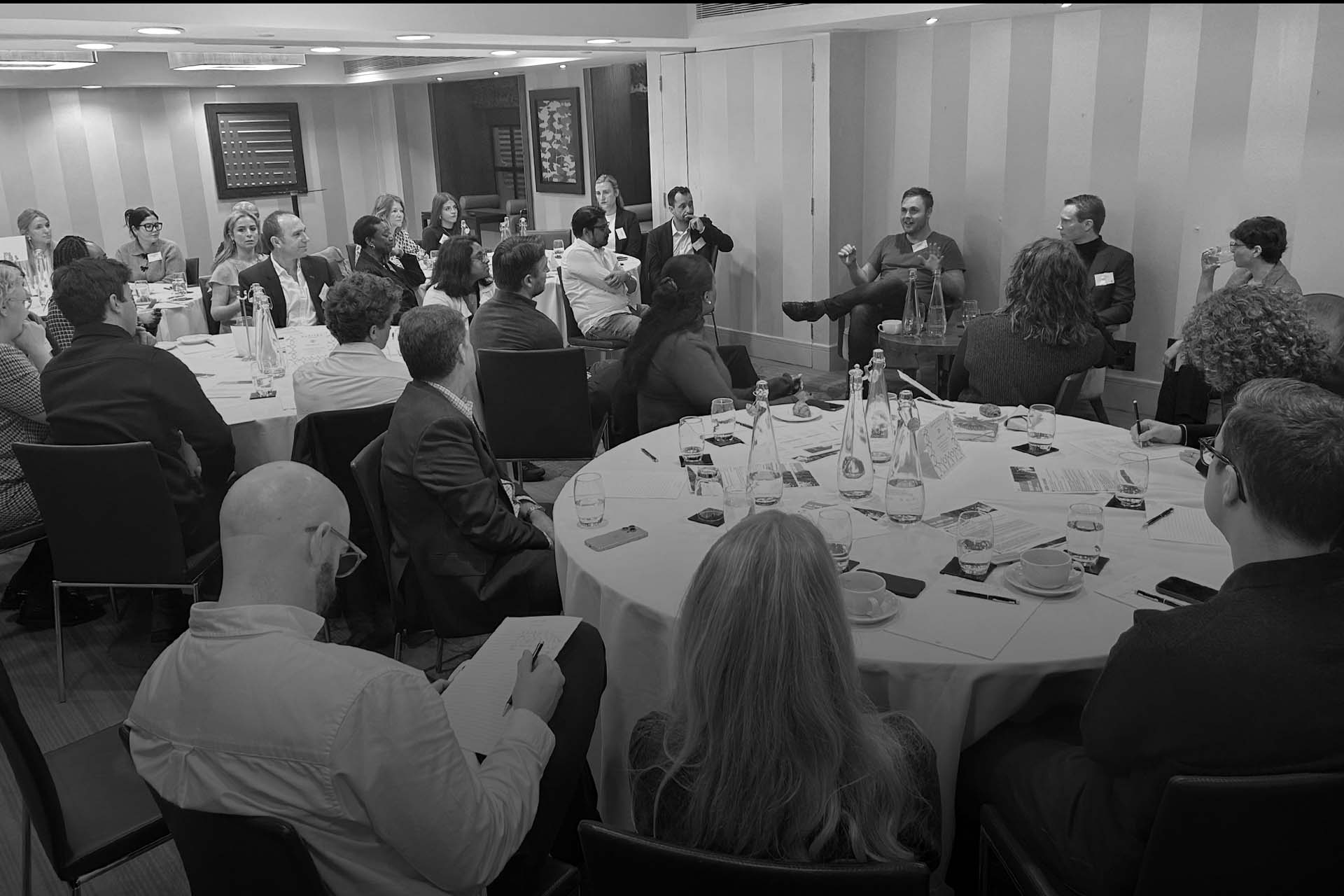
By popular demand, this session focused on the use of AI in ABM. And there was plenty to say. Thanks to all our incredible attendees who made this such a fun and lively event.
The buzz in the room was down to the senior ABM practitioners present. All from B2B heavyweights like EY, HSBC, Lloyds Banking Group, State Street, Verizon, BNY, Arup, ServiceNow, UI Path Mastercard and J.P. Morgan.
We were also thrilled to welcome AI consultant Jake Bird and Ui Path’s Chris Bailey, who shared their AI experience alongside Ei’s very own Angharad Gilbey.
Held under Chatham House rules, the frank, open conversation was backed up with juicy anecdotes and incredible experience across the floor.
This summary follows the main points discussed with no attribution. If they resonate, or you’d like to join the conversation behind closed doors, please contact Rachel Reasbeck or Tony Jarvis to put your name down for the next ABM Club, taking place later in 2026.
Here are the AI challenges that matter most for ABM leaders right now.
1. AI is powerful, but it’s not the craftsperson. We still need them.
Perhaps the most surprising anecdote of the day was the story of a major B2B company that is hiring talented human copywriters.
There is a fear that, while AI can speed up and automate process, what it generates will never quite be as brilliant as a human on their A-game.
When AI makes personalised content easy to achieve, what sets one brand’s content apart? ABM-ers in the room felt that it’s not enough for content to be informative, it needs to distinctive, even intriguing. Sometimes, less is more.
That eye for distinctiveness is uniquely human.
Culinary metaphors were the dish of the day – and one of the panelists described AI in ABM programmes as needing a ‘sandwich’ model.
Yes, it can do basic research, information synthesis, early-stage content ideas and can support in scaling 1: few programmes. But it lacks nuance, depth, human judgment and brand instinct. So, you can use it like this:
- A human initiates the task.
- AI accelerates and processes.
- A human refines and taste-tests — to ensure the final output is good quality.
The conclusion? AI can be a good cook in parts of the kitchen. It still needs a head chef.
2. We’re no longer just selling to humans.
A significant shift is underway.
Marketers are not only communicating with human buyers. We are increasingly communicating with AI gatekeepers that filter, summarise and interpret our work before a human sees it.
That changes things for ABM teams, and we need to control the flow of information to customers accordingly:
- Your content needs to be structured and clear enough for AI systems to interpret correctly.
- Anything bloated will likely be distilled by someone else’s AI.
If buyers are going to use AI to summarise your content, the consensus was that you’re better off distilling it yourself, so you control the narrative.
A question was raised on how to build sufficient brand authority and presence so that our content surfaces in AI responses. But the panel felt that we are a way from being able to properly influence what AI shows us.
3. Weak data is a blocker to effective AI use, and no one has mastered this yet.
One practical brake on AI enthusiasm in the room was its inability to support when data is weak.
A common problem for marketers is getting a tech stack that really works. We all know the term ‘garbage in, garbage out’. AI use compounds this problem.
The reality is simple: AI does not fix bad data — it amplifies it. When marketers layer AI tools onto inconsistent data in poorly governed tech stacks, we don’t create intelligence at scale; we create error at scale.
Another challenge holding AI back from being truly effective is not being able to connect AI tools to core CRM data. There are evident security concerns, but it’s still a barrier.
While these are issues, we can all take comfort – most people in the room hadn’t mastered this yet. As AI tools develop, the hope was that ABM teams can move away from using generic LLM tools like Copilot and Claude, towards more purposefully designed AI ABM tools, to help overcome data shortfalls.
4. If you want people to use AI, set the rules of engagement first. But be prepared for wildly different POVs.
One of the most practical debates centred on how best to build AI capability across teams.
What comes first — tools or training?
The consensus was that training matters, but not in the way people assume. AI literacy isn’t just about prompting skill (though that’s important). It’s about having a clear understanding of the governance framework for AI use. When AI guardrails are in place, teams are more confident experimenting.
AI adoption remains uneven and access does not always equal use. AI capability often falls to the lowest common denominator across a team, and this is often the case in sales teams, where AI use can lag.
At the other end of the enthusiasm spectrum, B2B marketers are grappling with unrealistically high expectations from senior leadership, who think that AI ought to be radically transformative right away.
Many ABM leaders are shaping the difficult internal narrative that AI is evolutionary, but not yet revolutionary.
5. There are ways to measure ABM performance beyond revenue metrics.
In the peer clinic, the conversation turned away from AI to focus on age-old operational challenges.
On question asked was: How do you measure ABM progress when it’s too early for meaningful revenue metrics?
Performance measurement could be a topic for a future ABM Club discussion (thoughts please!).
Demonstrating ROI on an ABM campaign in the early stages is a major challenge. You need to build momentum and excitement. You want to show progress. And you want the sales teams whose accounts aren’t currently in the programme to think, ‘Ooo, I’d like a piece of that!’.
So how do you do this?
Ideas included:
- Comparisons with control groups outside ABM programmes
- Scoring sales confidence
- Quality-of-conversation indicators
- Measuring engagement depth across priority accounts
Many of the challenges faced by those looking to create successful ABM teams were less about AI and more about operational alignment. We heard about overlapping team responsibilities, sales vs marketing tension, and cases where two teams owned communications to the same accounts and contacts.
Fundamentally – these are all issues that humans need to solve. Not easy to do, but AI can’t yet add a lot of value here.
The bottom line on AI use in ABM
AI is adding value to ABM today, particularly in initial research, data synthesis and intelligent scale across 1: few account programmes.
But it is not yet a transformational force. We still need human judgement to bring effective ABM to fruition and make sure the customer experience is distinctive and compelling.
AI will change how we execute ABM. But it won’t replace the need for strategic clarity and skilled marketing. In fact, these skills will be valued even more highly.
And for ABM leaders, that’s both reassuring and challenging.
Ei Advisory provides B2B sales and marketing intelligence that helps ABM teams reach, engage and convert customers. Contact Rachel Reasbeck to find out how we can help your ABM program be better.
Find out how Ei Advisory’s account intelligence can help your team build deeper knowledge of key accounts.
About the Author: Tony Jarvis
